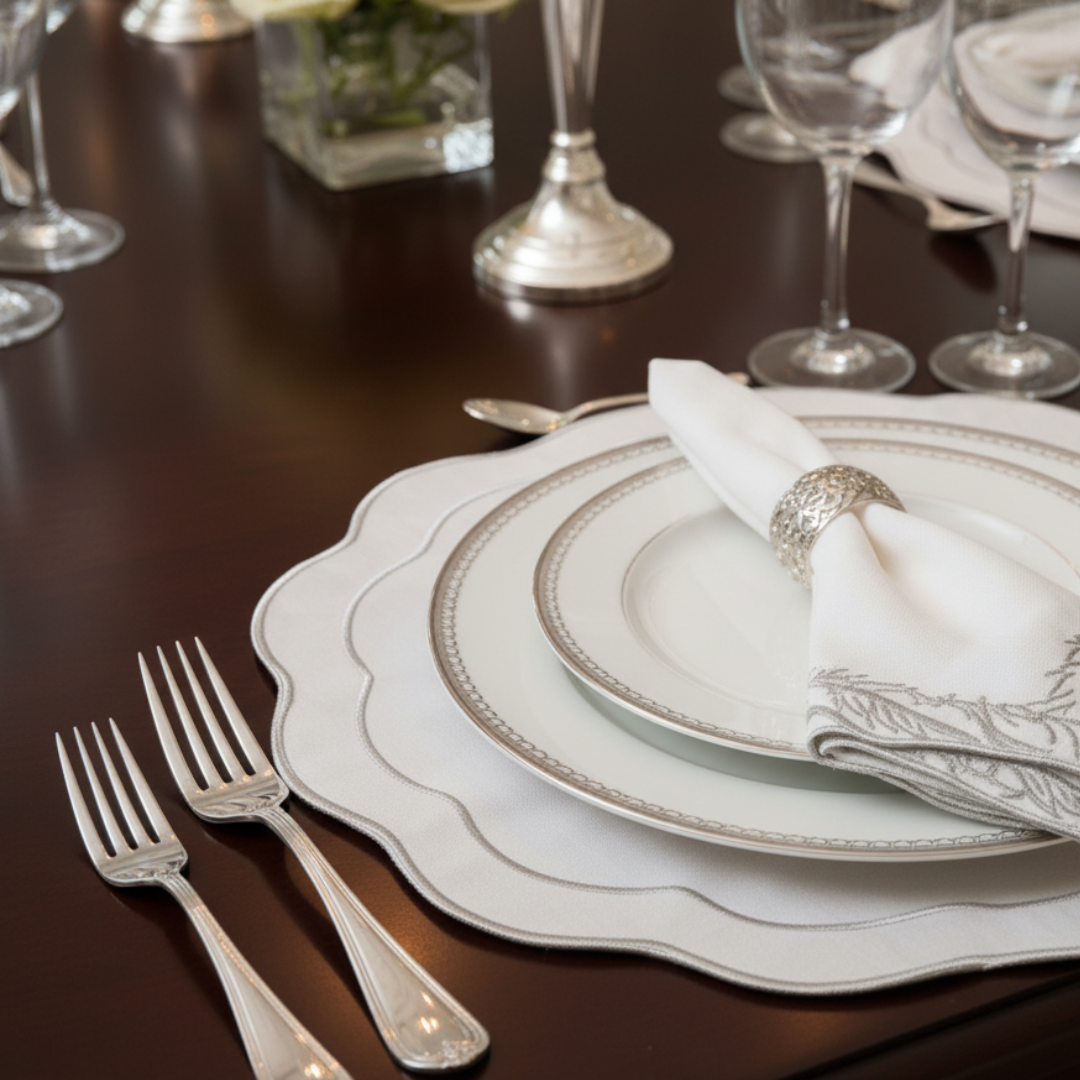




There is a particular quality of light that belongs only to an evening table set before guests arrive. The candles are lit, the glasses are already catching the flame, and the room holds its breath. In that moment, before conversation fills the air and the first course is poured, what your table says about you is already being read. The linen, the weight of it, the way light behaves against its surface — this is where dining room table decor ideas either reward the effort or reveal the shortcut.
Most people think about what they are serving. The ones whose homes are remembered think about what their table is wearing.
Begin With a Colour Intention, Not a Colour Scheme
The first decision in any tablescape is not the centrepiece. It is the ground. The linen beneath everything else sets the emotional temperature of the entire setting. A white cloth reads as formal but also as ordinary. A warm ivory reads as relaxed. A deep, considered black reads as deliberate — as evening, as intention, as confidence. When you choose a dark foundation for your dining table decor, every element placed on top — a glass, a plate, a candle — becomes more itself. Contrast does the work of drama without requiring you to be theatrical.
In Indian homes, where dining rooms often carry both natural daylight and warm evening light depending on the hour, a midnight black linen does something remarkable. By day it reads architectural. By evening, with candles or a warm pendant above, it transforms entirely — deeper, more alive, pulling gold and amber tones from everything around it.
The Relationship Between Texture and Light
Flat surfaces at a table are a missed opportunity. The finest dining room table decor ideas work because they create layers — not height, necessarily, but textural depth. A matte dinnerware piece against a linen with a metallic border. A rough-hewn stone candle holder against a cloth with precise embroidered detail. A polished brass vessel against cotton that has been finished with the kind of careful edge work that only reveals itself when you are close enough to touch it.
This is what hand-embroidered table linen achieves that printed or machine-finished alternatives cannot. The dimensional quality of the threadwork catches light at angles that shift as the evening moves — what appears as gold at seven o'clock reads as shadow and shimmer at nine. The table becomes a living thing.
Building the Monochrome Setting
Among the most considered ideas for table decor that translate across both intimate dinners and larger gatherings is the monochrome setting — not black-and-white, which can feel stark, but a singular colour family built through contrast of tone and material. Black and gold is perhaps its most authoritative expression. Not because it is fashionable, but because it has worked for centuries in the grandest rooms ever designed, from Mughal dining halls to Parisian brasseries.
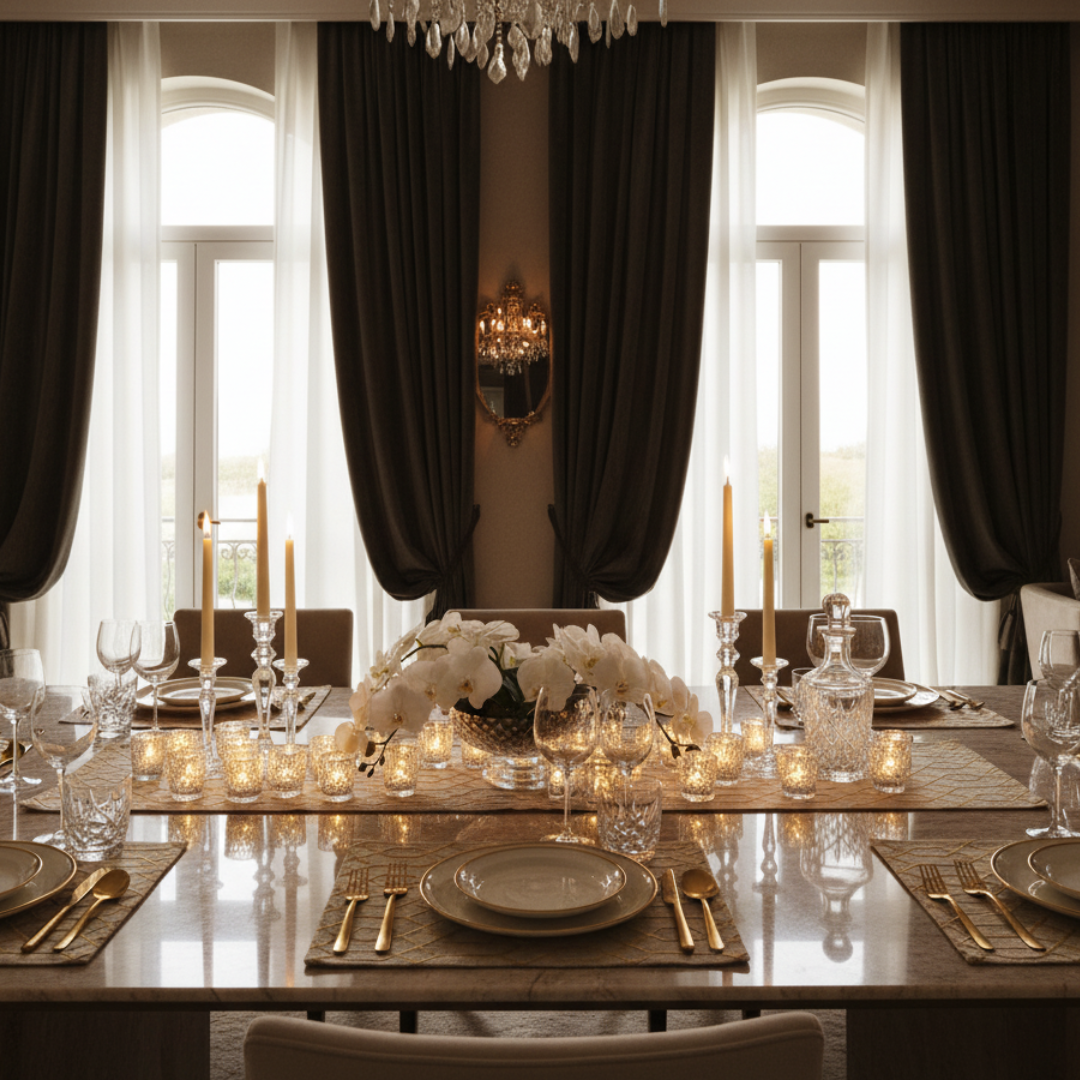
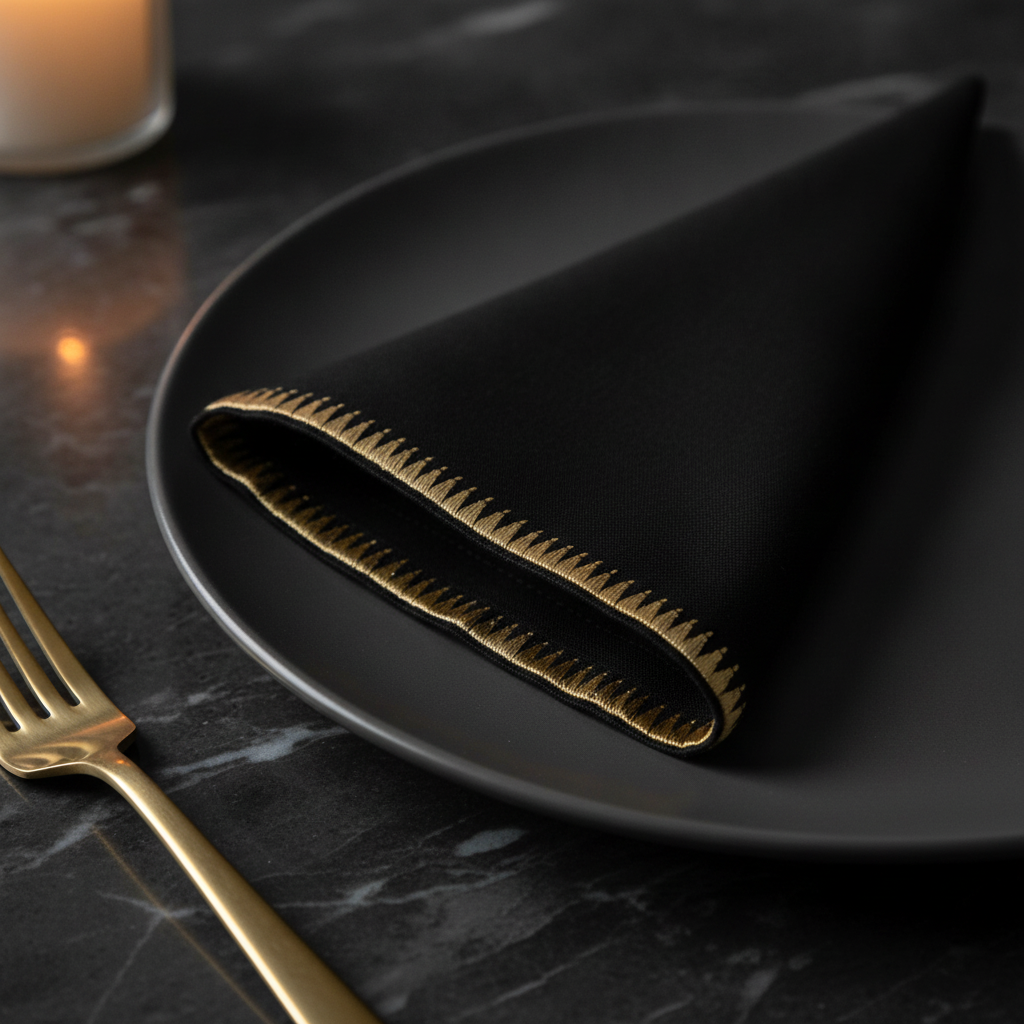
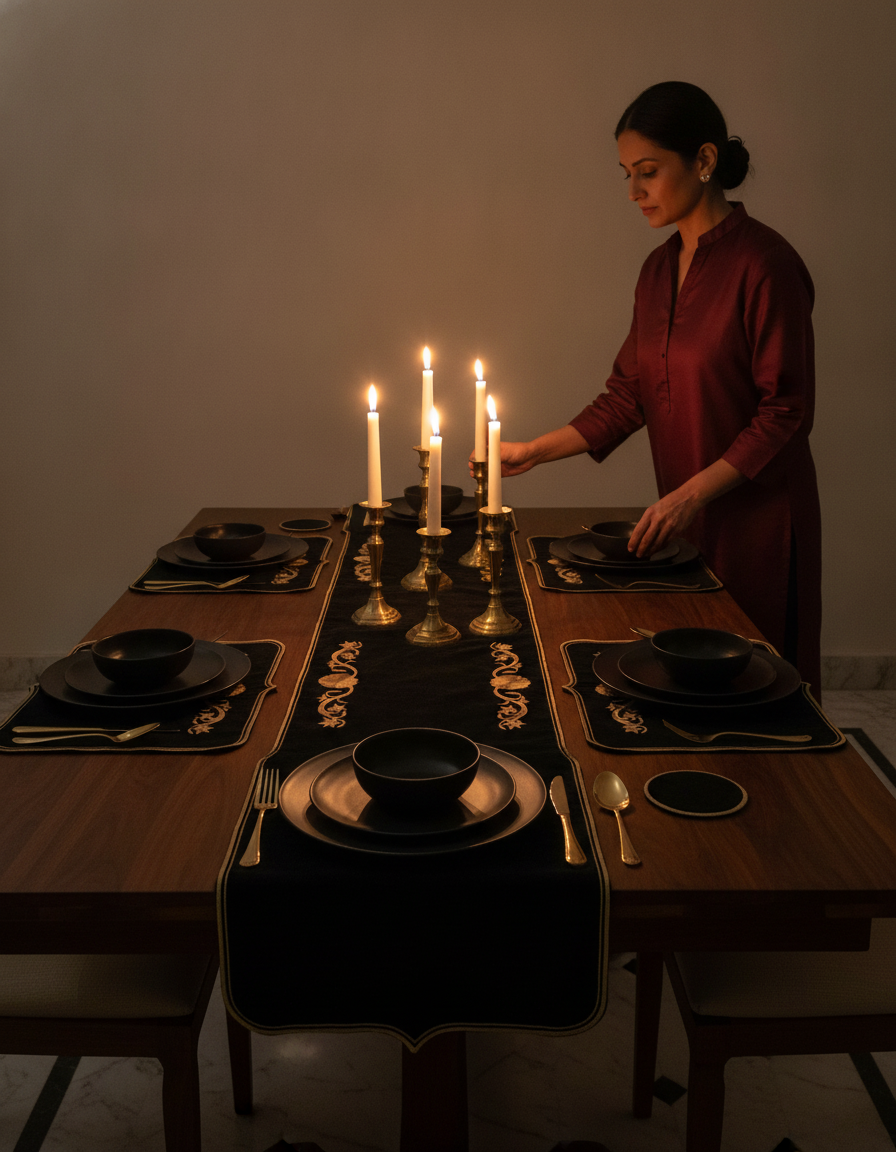
The mechanics of this setting are straightforward: a deep black runner or set of placemats as the foundation, matte or unglazed dinnerware in charcoal or jet, gold or brass cutlery placed with deliberate spacing, and a single centrepiece — sculptural rather than floral, or flowers in one colour, nothing mixed. The table napkin is where the detail closes the composition. When the napkin carries the same gold threadwork or border as the placemat, the table reads as a finished thought. When it does not, something in the eye notices, even if the guest cannot name it.
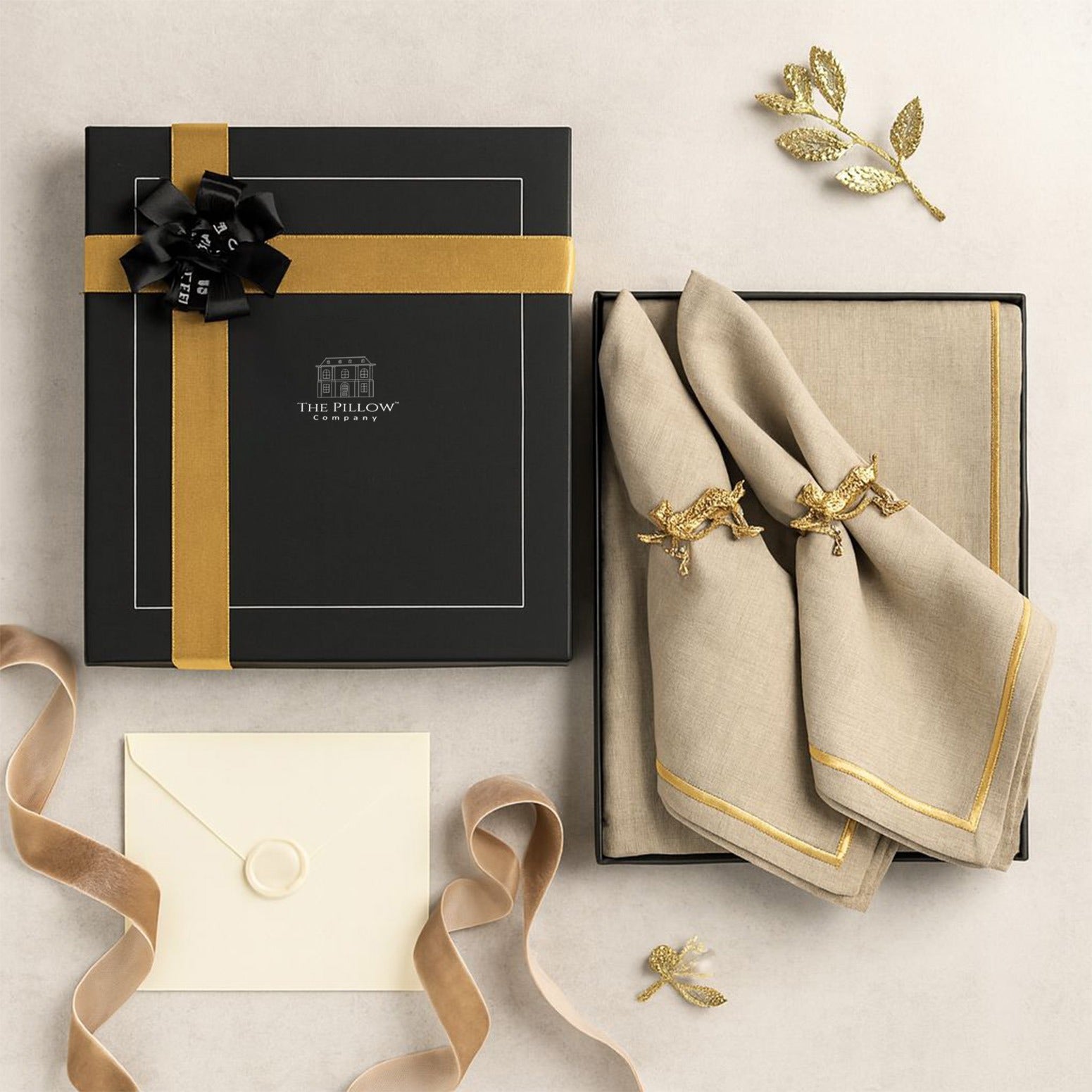
The Black Regal Dining napkins carry a precisely worked gold border in fine metallic thread — the kind of finishing detail that holds the setting together without competing with the dinnerware. In a monochrome scheme, the napkin is not decoration. It is punctuation.
Centrepiece Proportion and Negative Space
One of the quieter dining table decor ideas, and often the most useful, concerns what is not on the table. A setting that is fully covered with objects — votives, scatter petals, multiple runners, stacked items — reads as effort rather than ease. The homes that are genuinely admired, the tables that guests remember, tend to have considered negative space. A long table with a single low arrangement at its centre and nothing else competing. Two taper candles, not eight. One sculptural object, not a collection.
The proportion principle: if your dining table is a rectangle, your centrepiece should follow the same axis and scale to roughly one-third of the table's length. Anything taller than eye-level when seated interrupts conversation, which is, after all, the entire point of gathering. Keep height in candles, which narrow as they burn. Keep volume low and horizontal.
How the Table Linen Does the Heavy Work
In high-end hotel dining and the homes that feel like them, the linen is usually where the budget and the care have genuinely been concentrated. Everything else can be borrowed, rented, or sourced seasonally — but the foundation of good table decor dining is a cloth or set of linens with real material integrity. Cotton that has been finished properly does not pucker, does not shift out of placement, does not lose its drape when a glass is set on it. It behaves.
The difference between table linen that reads as considered and linen that reads as purchased is almost always in the finishing: the edge treatment, the weight of the fabric, the consistency of any embroidered detail across the full set. A placemat and napkin set that belongs together — not just in colour but in craft — brings the entire table into a single, resolved aesthetic. This is what the Dining and Table collection at The Pillow Company is built around: pieces that work as a composed set, not as individual items that happen to share a colour.
Occasions That Call for the Full Setting
The most practical of all dining room table decor ideas is also the simplest: build a setting you can use more than once. A well-chosen set of black and gold table linen is not a Diwali purchase put away in a drawer for eleven months. It is the right foundation for the dinner party in January, the anniversary table in March, the Eid table, the birthday dinner, the weeknight that you have simply decided deserves more than the ordinary. Occasion-specific décor dates. A considered palette does not.
If anything, the restraint of a monochrome setting is more adaptable than a festive one. The occasion announces itself through the food, the gathering, the conversation. The table does not need to do that work. It needs only to be beautiful enough to hold everything else.
The Table as the Room's Best Portrait
There is a photograph that every beautifully kept home eventually produces — taken from slightly above, looking down a long set table, candles burning, the light catching the glassware and the gold thread in the linen at the same moment. It is not a staged photograph. It is what a table looks like when its elements have been chosen with the same care as the room around it.
That image begins long before the guests arrive. It begins with the decision to treat the table not as a surface for food but as the most considered space in the home — the one that, for the hours of a meal, belongs entirely to the people gathered around it. The dining room table decor ideas that hold up over time are the ones built on that belief: that how a table is set is a form of welcome, and welcome is never a small thing.